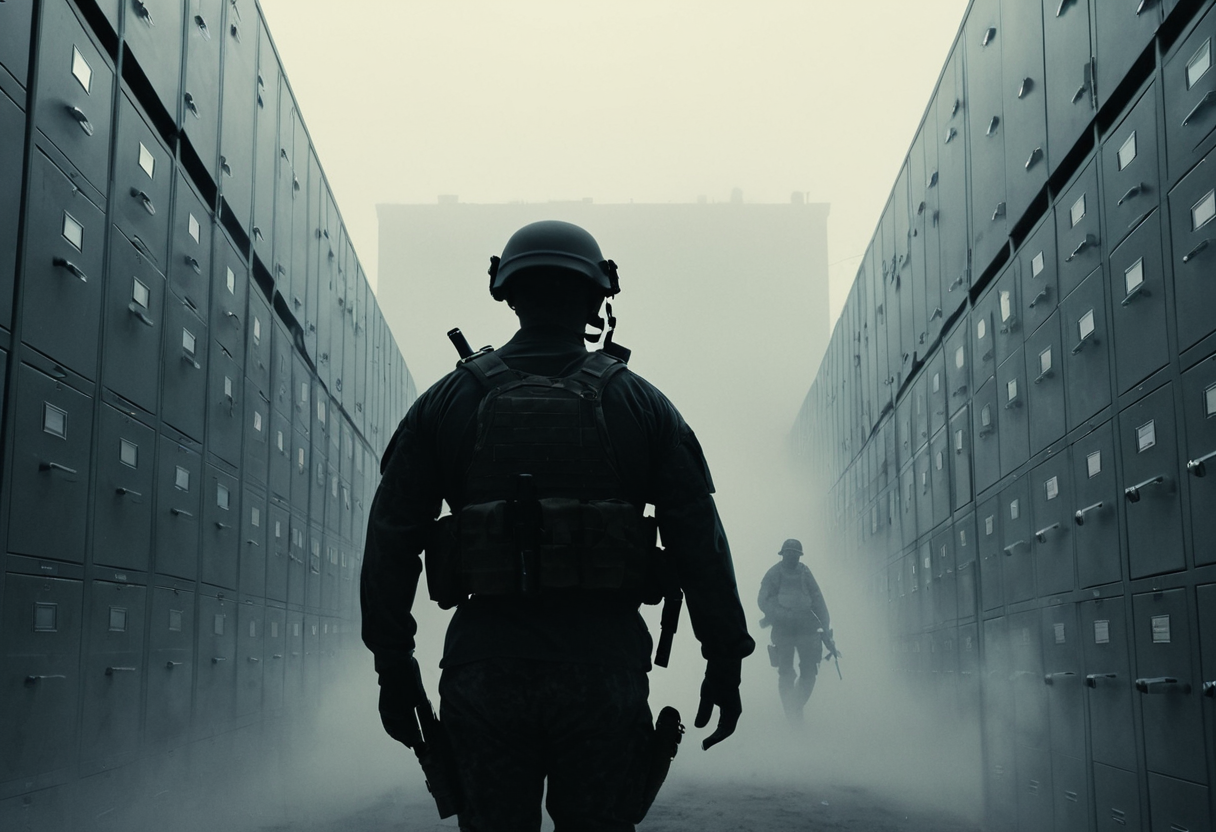
As a Joint Terminal Attack Controller (JTAC), I could take an aircraft overhead from first radio call to guns on target in less than two minutes.
Years later, as the guy responsible for JTAC software at Air Combat Command (ACC), I watched a single software change wait almost nine months for permission to exist.
Same department. Same war. Two clocks.
We renamed it the Department of War (DoW). We didn’t reorganize it for one.
BLUF: The Third Offset won't be decided by a weapon. It will be decided by a workflow: how fast an institution can observe, orient, decide, and act (OODA). Our adversaries aren't out-building us; they're out-iterating us. And the thing slowing us down isn't in Beijing or Moscow. It's ours.
Our most dangerous adversary has a CAC
Every offset was born from a crisis. The first turned the threat of Soviet armor into a nuclear deterrent. The second replaced the draft with professional volunteers, microchips, and precision.
Neither one worked because of the tools. They worked because America reorganized faster than its enemies could react.
The Third Offset is no different, except this time the thing we have to out-maneuver is us.
The Department's core machinery — the planning, programming, budgeting and execution (PPBE) cycle, the program objective memorandum (POM), the risk management framework (RMF) — moves at the pace of litigation, not conflict. Each review adds delay. Each delay erodes deterrence.
Our processes have become the problem they were built to solve.
Meanwhile, the People's Republic of China (PRC) pre-positions state-sponsored operators inside U.S. critical infrastructure.[1] We file those as incidents. They are battles, and we are losing them on a calendar.
Inertia has become our unofficial strategy.
Three things keep us slow
1. Temporal mismatch: the fight moves faster than the decision. Front-line drone units in Ukraine have been iterating software, firmware and tactics in weeks.[2] Our authorization and budget cycles measure in quarters and fiscal years. If you can't update it at operational tempo, you don't own it. You rent it from yesterday.
2. Cultural aversion: we punish failure more than stagnation. I made three promotions as fast as the system allowed, went to the Defense Innovation Unit (DIU) in 2016, and was never promoted again. I've written about why that's a selection filter, and why it can't scale. A system that taxes the people who take risks gets fewer of them, every year, on purpose.
3. Structural rigidity: nothing sunsets. Our requirements process was built for an economy that no longer exists. Pilots never die; they just stop delivering. AFWERX kept both its front doors running long after the only exit closed. Authorities, programs, and controls pile up with no expiration date, and every layer is someone's job to defend.
None of these is a technology problem. All three are plumbing.
Pockets aren't posture
We already know the Department can learn fast. DIU, AFWERX, NavalX, the Army Applications Lab (AAL), and the Marine Innovation Unit (MIU) have each proven it in their own corner.
But pockets aren't posture. An innovation shop that isn't wired into doctrine, budget, and command becomes an exhibit instead of a capability. It produces demos, then defends its headcount.
The organizations aren't the problem. The disconnection is. We don't need more cells. We need connective tissue that runs through the people, the money, and the authorities, so all three move in one loop.
The fix: weaponize feedback
The first offset weaponized physics. The second weaponized computing. The third has to weaponize feedback.
That means an institution where decisions create data, data reshapes doctrine, and doctrine resets the next decision. The goal isn't a faster bureaucracy. It's a learning one. The OODA loop was never just a fighter pilot's maxim; just ask every Marine officer. It's the blueprint for a Department that can out-think its enemies before it has to out-fight them.
I laid out the whole blueprint in Implementing the 3OS. It's about 28,000 words, and I stand by every one of them. But nobody fixes a department in one read, so over the next four weeks I'm breaking it into pieces that each fix one thing:
- People. How we rethink innovators and strategists, how we focus on software and deliverables, how DIU becomes a schoolhouse & how its graduates carry the practice back to the services.
- Money. Budgets that follow evidence instead of narratives, a better way to pick small-business winners, and making dual-use the focus, not the exception.
- Structure. Who owns standards, who owns authorization, and who owns risk.
- Cyber and lethality. Code as maneuver, and cheap mass as the answer to exquisite targets.
Every piece uses authorities the Department already has, except where I say plainly that Congress has to act.
The Third Offset should not be a program. It should be a reflex.
What you can do Monday
- Unit commanders: Pick one process in your unit that takes longer than the thing it governs. Time it. Write the number down.
- PEOs / PAEs: Find one review in your pipeline with no expiration date and propose one.
- Contracting officers: Measure need-to-award time on your last five actions, and share the slowest step.
- Service personnel offices: Count how many leaders of your innovation organizations were selected by name versus routed off a slate.
- DIU and the service innovation organizations: Report transition rates against everything awarded, not just what was completed.
- OSD: Put a sunset date on every new pilot, authority, and control.
- Congress: Nothing new to authorize yet. Ask for denominators: require transition rates reported against total awards.