
I made Staff Sergeant, Tech Sergeant, and Master Sergeant on my first look at each one. I was tracking to be a young Chief.
Then in 2016 I went to the Defense Innovation Unit Experimental (DIUx), and I was never promoted again.
I would do it again tomorrow. That's the problem.
BLUF: Almost every defense innovation organization we've built has followed the same arc — founded by people who paid a career price to be there, validated by results nobody expected, then rewarded with an org chart, a budget line, and a second generation of leaders who were never selected for the thing that made it work. The technology thesis was right. The manning model was the failure. We keep fixing the wrong variable.
We built a selection filter out of career damage
In the 1980s, going Special Forces was career suicide in the Army. No branch, no protected promotion path. A conventional-track officer who went to Group was telling his rater he'd stopped caring about being competitive. Which meant the people who went were, almost by definition, motivated by something other than rank.
That is a terrible personnel system. It is also an extraordinary selection filter.
My two years at DIUx took me off the path my Air Force Specialty Code (AFSC) leadership had decided was the path, and that was the end of it. Everybody in that building had paid some version of the same bill.
Look at what that self-selected group produced. The Commercial Solutions Opening (CSO) — the mechanism a meaningful slice of the department's commercial contracting now runs on — came out of that room. Lauren Dailey, Rob Trejo and David Rothzeid built it. Bill Greenwalt got the authorities into National Defense Authorization Act (NDAA) FY16 §804 and §815 that made it legal. A year later, NDAA FY17 §879 turned the CSO into a pilot authority for the whole department. That is not incremental. That is a permanent change to how the United States buys things, produced by a few dozen people who had all just torched their promotion timelines.
Here's the trap: you cannot scale a selection filter made of career damage. It works precisely because it repels people optimizing for promotion. The moment the organization succeeds, becomes prestigious, and starts showing up on assignment slates as a good job — the filter inverts. You now attract exactly the population it was designed to exclude.
Success destroys the mechanism that produced it. Every time.
Then we staffed a startup out of a promotion board
I have strong opinions about specific people who have run these organizations. I'm leaving the names out, because naming them lets you dismiss this as a grudge, and because the argument is stronger without them.
The point was never that the second-generation leaders were bad. The point is that nothing in the assignment system was ever designed to select for what the job requires. We built organizations whose function is disruption and then filled their leadership billets out of the same machine that fills every other leadership billet — a machine optimized for time-in-grade, completed professional military education (PME), and a clean record. Nobody in that pipeline was ever measured on time-to-field, or on whether they could survive an argument with a program executive office (PEO).
Bryon Kroger has put his finger on the sharpest version of this. No successful startup swaps out its entire C-suite every two or three years. Not one. It would be understood as a catastrophe — the loss of institutional memory alone would be fatal, to say nothing of what happens to a strategy that has to be re-litigated with a new executive team every eighth quarter. We do exactly that to every military organization we own, deliberately, as policy, and we call it professional development. For a squadron flying a mature platform against a known mission, the cost is manageable and the benefit is real. For an organization whose entire product is a bet that takes five years to pay off, it is disqualifying. The commander who placed the bet is gone before anyone can tell whether it worked, and the one who inherits it has every incentive to start something new that will be legible on their own officer performance report (OPR).
The one place this doesn't happen is the place where the assignment system doesn't reach.
DIU's appointed directors have been consistently good. Raj Shah, Mike Brown, Doug Beck, Owen West — different backgrounds, different eras, different administrations, and not one of them is observably worse than the one before. Four generations of leadership and no decay at the top.
Every one of them was selected by name, for that job, by someone who cared how it turned out. Not one came off a slate. Not one was routed there by a machine optimizing for time-in-grade and a clean record. Not one arrived on a two-year clock with an OPR riding on the outcome. DIU is the only organization in this ecosystem whose senior leadership is chosen the way you would choose a Chief Executive Officer (CEO) — and it is the only one that hasn't degraded at the top.
That is not four lucky picks. That is a natural experiment with an unusually clean result.
Everywhere the assignment system selects the leader, we get the arc I just described. Where it doesn't, we don't.
And DIU sharpens it further from the inside. The wobbles in its history line up with the stretches when it reverted to the default — an acting director pulled from inside to hold the seat until the system produced somebody. Same mission, same authorities, same building. Different selection mechanism, different (significantly worse) result.
Which is the entire argument in one organization: the fix isn't a better org chart, it's a better way of choosing who runs it. Everything eroding at DIU now — budget structure, Pentagon process creep — is happening despite good leadership, not because of it. That's a budget and process story, and it gets its own section below.
In the service organizations the founders can't stay, because we gave them no reason to. There is no career model in which a MSgt or a Major does two tours in the innovation ecosystem and comes out ahead. So they leave — to industry, to venture, to the reserve component — and the institution reconstitutes itself around whoever the system sends next.
That's the theory. Here's what it looks like on the ground.
Kessel Run: the whole thesis inside one organization
You don't have to take my word for any of this, because the people who built it said it out loud on a stage I was moderating.
Kessel Run came out of the DIU bloodline. Enrique Oti was working public-private cloud infrastructure at DIU before he ever took command in Boston. Bryon Kroger was an intel targeteer who went and learned acquisitions. Exactly the profile above: operators who took a career detour into a function the personnel system had no slot for.
And it worked, in exactly the way DIU worked. The policy legacy is the durable part. Continuous authority to operate (cATO) is Kroger's coinage. The software acquisition pathway, the acquisition strategies, the career-field work — Kessel Run did the unglamorous statutory labor that every software factory since has inherited. It also made software cool in an Air Force that had killed its officer software career field outright: from tens of thousands of coders in the 1980s down to roughly 450 by the time Kessel Run stood up. Traditional primes changed how they built and delivered software to match. That is a permanent change to an industry, made by a few hundred people in Massachusetts.
Then look at what happened to it.
Oti was told, as a condition of taking command, that he had to absorb the legacy portfolio — F-35 ALIS, PEX, C2IMERA, the rest of it. By the time he left, Kessel Run had 1,200 people and roughly 400 of them were doing the thing Kessel Run existed to do. Kroger had explicitly warned him not to merge them, because the culture wouldn't survive the blend. It didn't. Oti's own word for it is dilution.
The temporary duty (TDY) budget — the money that put software teams next to their users in theater, which was the entire mechanism of mission focus — got cut by 75%. The modular contracting strategy was supposed to convert to firm-fixed-price in year four so vendors could actually be held accountable. That conversion never happened. Four contractors on one mixed-badge team and no way to fire any of them.
And the platform. Kessel Run's first platform was commercial off-the-shelf (COTS). They bought it and delivered it into an Impact Level-5 (IL5) environment in the desert in 120 days. Then, around 2020, the organization decided to build its own — and four years later, when Rich Lopez arrived, it still had not delivered to the field.
They rented a working platform in 120 days, then spent four years building one that didn't ship. That is the entire institutional arc in one line item.
On the Air Combat Command (ACC) fight, I have a view from the other side of the table. Oti says now that he chose the wrong hill — that Kessel Run never belonged under Air Force Lifecycle Management Center (AFLCMC), that it should have been owned by the warfighter in a command structure, and that pushing it wrecked his relationship with both ACC and the center he was assigned to. I agree with his premise completely. Kessel Run under a lifecycle management center was a category error, and much of what followed flowed from it.
What I'd add is what it cost the people carrying the message. I was at ACC in that era. ACC was not mildly skeptical; A5 was actively hostile, and the day-to-day was ugly in a way that doesn't show up in any retrospective. But here's the part that matters: those detractors were convertible. They weren't ideologues. They were people trained across an entire career to be the recipient of a finished product — to test it, validate it, approve it — and they were being told that model was obsolete by captains in T-shirts. That's a persuasion problem, and persuasion was available. It took hands-on work, repeated trips to Langley, and people willing to spend their own credibility. Some of us did it. It wasn't enough, and it never scaled, because nobody's job description included it and nobody was evaluated on it.
That's the structural point hiding inside the personality story. Every one of these organizations depends on a small number of people doing unfunded relationship work with the staffs that own their requirements. When those people leave — and they always leave, because there's no career in it — the relationship reverts, and the next generation inherits an institution that thinks the innovation shop is a threat.
And here is why I'm not interested in blaming whoever was holding the bag. Ask three generations of Kessel Run leadership what went wrong and you get the same answer from all of them. Oti: we never built a workforce pipeline, we needed military coders from E-1 to four-star, and we didn't get the backing. Kroger: the talent wasn't there, the cavalry never came, and if he were sitting in the chair today he'd have made the same call. Lopez: he believes in organic software development and pivoted to industry anyway, because the developers he was promised never arrived and he had to deliver something.
Three leaders, three eras, one diagnosis. They were never given a manning model. Everything else — mission creep, platform wars, the TDY cut, the contract strategy that never converted — is downstream of an organization built on heroics by people the assignment system had no way to reproduce.
Kroger's version is the most honest thing anyone in this community has said publicly: the bureaucracy and the policy barriers are real, but a lot of the time we just weren't good enough. That's the correct posture, and it's why the fix is a pipeline and not a memo.
You cannot get good enough at something you only staff by accident.
AFWERX: two front doors and no hallway
Kessel Run is the argument at the scale of one organization. AFWERX is the argument at the scale of the entire small-business industrial base — because AFWERX was never one organization. It was three in a trench coat, and the two still standing are the two that were never responsible for delivering anything.
AFVentures was the front door for industry, and a genuine historic success. The Open Topic model — stop writing narrow technical requirements, let companies tell you what they've built — pulled in an enormous population of firms that had never touched the defense market and would never have bid on a conventional topic. It worked so well that Congress made it mandatory: Section 7 of the Small Business Innovation & Research (SBIR) and Small Business Technology Transfer (STTR) Extension Act of 2022 directed Department of Defense (DoD) to establish open topics, and the rest of the department had to adopt what AFWERX invented. AFWERX has now put more than $7 billion through roughly 10,400 contracts.
The Strategic Financing Increase (STRATFI) model AFWERX employed worked well enough that the 2026 SBIR re-authorization created a STRATFI-style strategic breakthrough award for the rest of the Department. For the second consecutive time, Congress treated an AFWERX AFVentures policy prototype was a blueprint for the rest of the Department to copy.
Measured as a front door, AFVentures is the most successful thing anyone in the entire defense ecosystem has built. That's not a hedge before the criticism. It's the record.
Spark was the front door for Airmen, and it was the bigger failure. Spark pushed innovation authority down to the installation and asked the force to surface its own problems — and the force did, enthusiastically, because Airmen have always known exactly what's broken on their flight line. What Spark never had was manning or money to move any of it. Somebody identifies a real fix, wins the pitch, gets the challenge coin and the glossy photo — and then there's no billet, no program office, and no funding line to carry it past the wing. Under second- and third-generation leadership this got worse rather than better, for the least dramatic reason available: nobody was ever resourced to do the transition work. We built a suggestion box and called it a program.
The Prime line was the only exit AFWERX had. Agility Prime and its siblings Autonomy and Integration existed to do the hard thing: take a company out of Phase II and drive it into Phase III, into a program office, into a program of record. When AFWERX was delivering on Prime, the Phase II-to-Phase III conversion for those efforts was strong. For everything outside the Prime line, my read — from the inside, over years — was well under 5%. Transition to a PEO was close to nonexistent.
Then AFWERX stopped delivering on Prime.
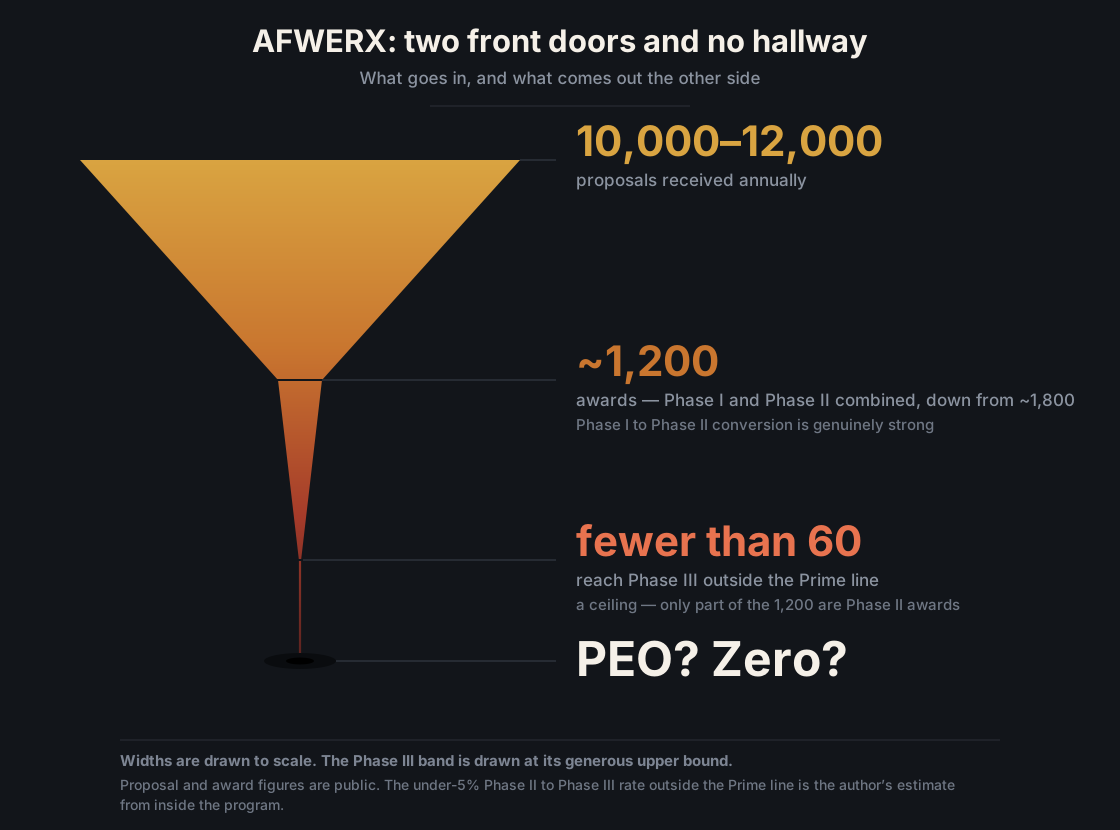
Sit with the shape of that. Two intake mechanisms, one exit mechanism. The exit died under subsequent AFWERX leadership and both intakes kept running. The organization retained every function that generates countable outputs — proposals received, awards made, Airmen engaged, dollars obligated — and lost the only function that produces fielded capability. Awards fell from roughly 1,800 in one year to roughly 1,200 the next, against 10,000 to 12,000 proposals annually.
We built the widest front door in the history of defense acquisition and then quietly stopped maintaining the hallway.
This is a disease, not an incident, and DIU shows the same symptom in a milder form. From FY16 to FY23, DIU made 450 prototype awards and reported 62 transitions to production. That gets briefed as a 51% transition rate, which is defensible — it's 51% of completed prototypes. It is also 14% of everything awarded. Both numbers are true. Only one gets used.
When a metric needs a qualifier to survive contact, the qualifier is the finding. An organization under pressure to demonstrate value will always drift toward the number it can produce on demand. Proposal volume is easy, immediate, briefable. Driving a Phase III through a program office is slow, requires picking fights with people senior to you, and the win posts three years after your permanent change of station (PCS). A leader selected by the ordinary assignment process optimizes for the first one every time — not out of malice, but because that is what the system that sent them there rewards.
And the damage lands on everyone we asked to believe us. Tens of thousands of small companies were invited into the defense market through a door that opens onto a room with no exit; we taught a generation of founders that a Department of the Air Force (DAF) SBIR is a grant, not a path, and the ones who figure that out leave while the ones who don't become SBIR mills. We told a generation of Airmen their ideas mattered, collected them, and shipped almost none of them. And the warfighter — the only reason any of this was ever authorized — got a decade of proposal counts instead of capability.
Three populations, three promises, none of them kept.
You only get to do that to people once.
The org chart tells you the rest
Once you know what you're looking at, the wiring diagram is enough.
Chief, Digital & Artificial Intelligence (AI) Office (CDAO) stood up in December 2021 as a direct report to the Deputy Secretary of Defense. That reporting line was the point — it was the entire argument for the elevation. In FY26 it eliminated its Chief Technology Officer (CTO) directorate. In August 2025 it was realigned under the Office of the Under Secretary of War for Research & Engineering (OUSW(R&E)). In a memo dated 9 January 2026 (released 12 January), it was folded, alongside DIU, Strategic Capabilities Office (SCO), Defense Advanced Research Projects Agency (DARPA), Office of Strategic Capital (OSC), and Test Resource Management Center (TRMC), under a single Department of War CTO. Four years from a direct report to the DEPSECDEF to a box inside somebody else's operating system.
NavalX was created in February 2019 under Assistant Secretary of the Navy for Research, Development & Acquisitions (ASN (RD&A)) — the service acquisition executive, one hop from the decision maker. Today its homepage lives at onr.navy.mil/organization/navalx. You don't need a leak to see that. The URL alone is the demotion, but peeling back the policy changes you see that NavalX now lacks many of the authorities it had when founded.
Jack Shanahan, who ran Maven and the Joint Artificial Intelligence Center, said the quiet part out loud about the consolidation: when you pull an organization out of the deputy's span of control, the message to the force is loud and clear, whatever the intent.
The money was supposed to fix it. The strings attached made it worse.
DIU's FY24 funding was more than $983 million, a roughly five-fold increase over the prior year. That was widely read as the fix. Finally, real money. Finally, no more begging.
Consider what actually changed. When DIU was arguably at its most effective, it spent other people's money. That was not obviously a better process — it was fragile and it was undignified; DIU needed the budget increase, and there have been real programmatic successes in the last two years that exist only because of it. But when DIU didn't have their own budget, it meant that program managers, middle management, and senior leadership at DIU were not accountable for a program objective memorandum (POM). They were accountable for results, because results were the only thing that kept partner organizations writing checks. That is the accountability structure of a startup, and it produces startup behavior.
Give the same organization its own program of record and force it to fight for it like any other acquisition executive, and you have handed every leader in it a second job: defend the line. Defending the line rewards forecast accuracy, spend rate, and the absence of embarrassment. It punishes the fast, cheap, public failure that is the entire point of the enterprise. Add the bureaucracy creep coming out of the Pentagon — Washington Headquarters Services (WHS) in particular — and you have neutered the advantage the money was supposed to buy.
We funded the organization and defunded the behavior.
The solution is to fund DIU but let it continue to run like a start-up and make warfighter results the reported data, not POM or PEO specific oversight. Any action that makes DIU — or the service equivalents like AFWERX or NavalX — more like a PEO or a research lab is a step backwards that penalizes the warfighter, the tax payer and the commercial sector.
The thesis was right. That's what makes this infuriating.
DIU's 2015–2018 argument was that the next war would be decided by who could pivot dual-use commercial technology into warfighting faster than the other guy. Pentagon leadership found this funny. The small unmanned aerial systems (sUAS) work in particular was treated as a hobby by people whose seriousness was measured in PEO-validated requirements and ten-year fielding timelines.
Ukraine settled it. So did every AI capability the department is now sprinting to buy from vendors it spent a decade refusing to talk to. Emil Michael's framing — that building bespoke in-house AI was a dead end and the commercial sector had already spent the money — is the 2016 DIUx pitch, delivered a decade late, by the building that laughed at it.
And here's the part that matters: the people at DIUx were not smarter than the people in the Pentagon. They had no special insight. What they had was a culture that treated disruption as the job, rewarded failing fast and learning from it, and ran on commercial tempo because it had no other option.
The culture was the asset. We keep trying to scale the checkbook instead.
The fix is a career track, not another memo
Stop building organizations. Start building a career track — modeled on Weapons School, not on a startup.
Keep people attached to their core function. A Joint Terminal Attack Controller (JTAC) stays a JTAC. A contracting officer (KO) stays a KO. The identifier is additive, not a departure. Mission investment is the whole point, and you lose it the moment someone becomes a full-time innovation professional. They just become another acquisition officer with more venture capitalists (VCs) in their rolodex.
Make the schoolhouse real. Revive the Defense Ventures Fellowship as part of a comprehensive curriculum. Use exchanges with industry as the centerpiece of a formal course structure complemented by curriculum that DIU oversees. A school assignment, tracked and coded like any other — not a favor someone's commander grants.
Code it, then make it pay. A special experience identifier (SEI) that is prioritized at promotion boards, not merely tolerated by them. This is the single highest-leverage change available: make the two years I spent at DIUx a promotion accelerator instead of a career stop, and tie it to skills that are currently incentivized for leaving the Department instead of transforming it.
Tier the career, like the patch. Tier 1 back at a line unit inside their own AFSC/Military Operational Specialty (MOS)/rate, applying it. Tier 2 into service innovation organizations (like AFWERX, or NavalX). Tier 3 into joint and department-level billets (like DIU or OSC). By the time someone is running AFWERX, they've spent fifteen years being selected for this, and they arrive with a peer network that remembers what the job was for.
That's the whole fix. It's a manning solution rather than an org-chart solution, which is why nobody wants it — you can't announce it at a conference and you can't see the results for a decade.
Every reorganization memo we've written instead has been an attempt to get a cultural outcome out of a wiring diagram. Six organizations under one CTO is not an innovation operating system. It's the same six organizations with a shorter route to the person who can tell them no.
We know how to build the people. We've just never been willing to pay them for it.
Kessel Run material drawn from the Fed Supernova post-mortem panel with Enrique Oti, Bryon Kroger, and Col. Richard Lopez.