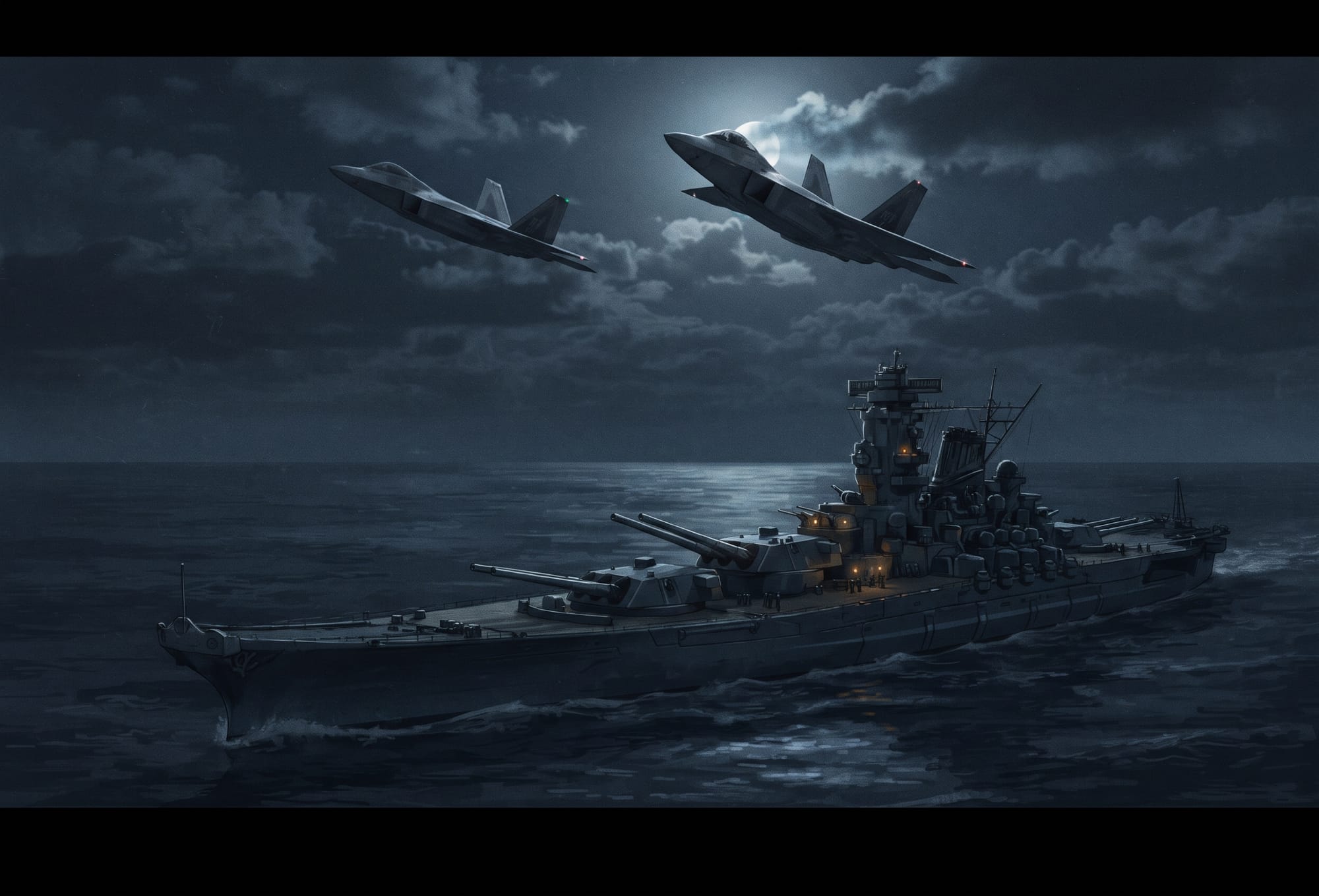
The F-22 Raptor is the most dominant air-superiority fighter ever built, and in two decades of service its only air-to-air kill is a Chinese surveillance balloon it shot down off the coast of South Carolina.[1]
That sounds like an indictment. It's the opposite. It's the highest compliment you can pay a fighter.
BLUF: Exquisite platforms earn their keep by eliminating an entire class of warfare, not by running up a score. The F-22 made air-to-air combat a non-event the way the aircraft carrier made the battleship broadside obsolete, and that is worth paying for. But the enemy gets a vote, and a thinking enemy never fights your exquisite system on its terms — they pivot around it. The Yamato and the balloon teach the same lesson: win the old class of warfare, then pivot to the new one before someone pivots on you. The pivot is cheap mass, and we are late to it.
The highest compliment is no kills
Grant the exquisite force its due, because it has earned it. The Raptor's empty tally isn't a failure of the airplane; it's a measure of how completely it closed the air-to-air problem. Nobody flies against it, and that is the whole point. Deterrence that works looks like nothing happening. The Next Generation Air Dominance (NGAD) fighter, now the F-47, is being bought to keep that class of warfare closed, and a platform that makes an entire category of enemy action pointless has done something a thousand attritable drones cannot.
So this is not a cheap shot at expensive airplanes. The mistake isn't building the exquisite platform. The mistake is believing the platform is the war, and that having won one class of warfare means you get to keep fighting it forever.
The real argument was never exquisite or cheap. It's how much, and for how long. You need a handful of F-35s to kick down the door on the first night of a short, high-end fight. You do not need a thousand of them loitering over a decade-long one. The tired debate — “a fleet of F-35s instead of A-10s” — has it exactly backwards: keep the F-35 for the opening, exquisite, temporary phase, and recognize that persistent close air support (CAS) at low cost is the vital, enduring demand the force keeps starving; the cost per flight hour (CPFH) of exquisite assets for sustained operations tends to be insane. Run the same logic forward a generation and it still holds: a few F-47s to win air dominance in the opening act, and a swarm of unmanned aerial systems (UAS) to carry the persistent fight that comes after. Exquisite is a scalpel for the first week. It was never meant to be the whole surgery.
And when the job really is short and sharp, this force has no peer — so keep it that way. The raid into Venezuela to seize Nicolás Maduro was run almost entirely on legacy, Prime-built platforms,[2] and it worked precisely because that is the war they were built for: a fast, lethal, high-end action over a short timeline, with nothing to sustain. For that mission — the decapitation strike, the door kicked in, complete neutralization of a supposed dangerous integrated air defense system (IADS) and the team home by morning — we have built the finest instrument in history, and we should guard it jealously while making it even better. The error is only in forgetting its edges. Try to run that same force at theater scale and for years, instead of one capital and a single night, and you are no longer wielding a scalpel; you are back in the seventeen-million-to-one trade, the exquisite side of every exchange, imposing the cost on yourself.
We never fought the Yamato
Here's the part the exquisite-platform shops forget. We never dueled the Yamato broadside to broadside. The most powerful battleship ever floated, and the United States Navy never once laid a battleship alongside her to trade salvos. We sank her from the air, because by 1945 the carrier had already turned the battleship duel into a museum exhibit. The side that pivots to the new class of warfare wins. The side that insists on refighting the last exquisite duel loses, even when its platform is the better one. Yamato was superior to anything we floated against her, and it did not matter at all.
I built that short film years ago at AFWERX, back when the F-47 was still just NGAD. In it the fighter is told to turn around because the enemy has already taken down what it needs to fight, and the turnaround point happens to sit over the Yamato's grave. I meant it as a joke. I believe it a little more every year.
The enemy pivots too
The enemy pivots too, and it doesn't take our budget to do it. In June 2025 Ukraine ran Operation Spiderweb: cheap drones, smuggled deep inside Russia in trucks, destroying strategic bombers on the ground at bases thousands of miles from the front.[3] It was politically easy, nearly free, and it did to a strategic air fleet what no dogfight ever could. Ironically, I had predicted a version of Spiderweb in that video above in 2024, because in 2016, we'd planned out another version of it in a conference room at the Defense Innovation Unit (DIU).
That is the move that sends our F-47 home: not an enemy fighter it can out-fly, but a cheap, deniable strike on the tanker, the runway, the base, or the data link it cannot perform without. The exquisite platform is never more vulnerable than when it's parked, and the enemy has every incentive to fight it there, where it's a target and not a Raptor. A politically popular, dirt-cheap Spiderweb beats an unaffordable dogfight every time, because the enemy gets to choose, and they will never choose the fight you built for.
You don't beat the Yamato broadside to broadside. You sink her from the air — and then you watch for whoever's building the next carrier.
Which exquisite, and where
The next carrier may be a container ship. The same trick that lets us hide a drone magazine in a shipping box — DIU's containerized launch-and-recovery work, and the proposals to scatter those boxes across the First Island Chain — is just as available to the other side.[4] Rheinmetall already sells a standard shipping container that launches a loitering-munition swarm, and has demonstrated it firing from a moving truck.[5] When any flatbed, any coaster, any anonymous box stacked on a civilian hull can launch a swarm, "what is an aircraft carrier" stops having a clean answer. The threat stops being a platform you can find and sink, and becomes a capability riding inside the civilian economy, on both sides of the strait.
That doesn't retire the exquisite force; it sorts it. Some exquisite platforms are worth more than ever precisely because the swarm can't find them — a Columbia-class ballistic-missile submarine is a survivable national deterrent, and worth every dollar. Others have quietly become death traps: an M777 towed howitzer, parked and radiating the moment it fires, is now a cued target for a few-hundred-dollar quadcopter. "Trim the exquisite" was never "cut the exquisite." It is cut the exquisite the enemy can now kill cheaply, and double down on the exquisite he still can't.
And it turns on where you mean to fight, because these are two different wars. If the Navy has to beat China on the away game — choking the tankers and the trade transiting the Malacca Strait, a continent from the mainland — that is largely an exquisite fight, and we should want the best blue-water Navy on earth to wage it. But a carrier battle group off the Formosa Strait is the wrong asset for the home game. Against mainland hypersonics and UAS mass counted in the thousands, a Nimitz or a Ford would burn so much of its magazine just staying alive that it could project almost nothing for the island it came to defend. Same Navy, opposite answers, because the geometry is opposite. An exquisite platform isn't good or bad; it's right or wrong for the sea you're standing in.
The fix
Keep the exquisite force, and be honest about what it is for: holding a class of warfare closed, measured in deterrence, not kills. Then cap it at what that mission actually needs, and spend the margin on the pivot — the cheap, sustained mass that fights the probable war and can't be wiped out on the ground as cheaply as a row of parked bombers, crewed by a force broad enough to wield it. The Raptor already won its war. The only question left is whether we fund the next pivot or spend the decade polishing the last one, waiting for a dogfight that will never come while the trucks roll up to the flight line.
What you can do Monday
- Unit commanders: Assume the exquisite enablers you lean on — the tankers, the airborne early-warning jets, the bases, the data links — are the target, and train to keep fighting the day they're gone.
- PEOs / PAEs: Measure air-dominance programs by the class of warfare they close, not by a kill count that will never come, and ring-fence the pivot money so it isn't raided to feed the flagship.
- Contracting officers: Buy the cheap pivot capacity alongside the exquisite platform, written into the same strategy, not as a leftover after it.
- DIU and the service innovation organizations: Build the Spiderweb we'd rather run than receive — cheap, deniable, mass — and the base defenses that assume the other side is building one too.
- OSD: Cap the exquisite portfolio at what it takes to hold the class closed, and program the pivot to cheap mass as a requirement, not a bill-payer.
- Congress: No new authority needed. Ask the Department two questions about every flagship program: which class of warfare does it close, and what happens the day the enemy pivots around it? If there's no answer to the second one, you're buying a Yamato.
Works Cited
1 Defense One. 2023. F-22 Shoots Down Chinese Balloon off Coast of South Carolina. February 4.
3 BBC News. 2025. Ukraine's Audacious Drone Attack on Russian Bombers, Explained. June.
The conversation happens on LinkedIn — come argue with me there.