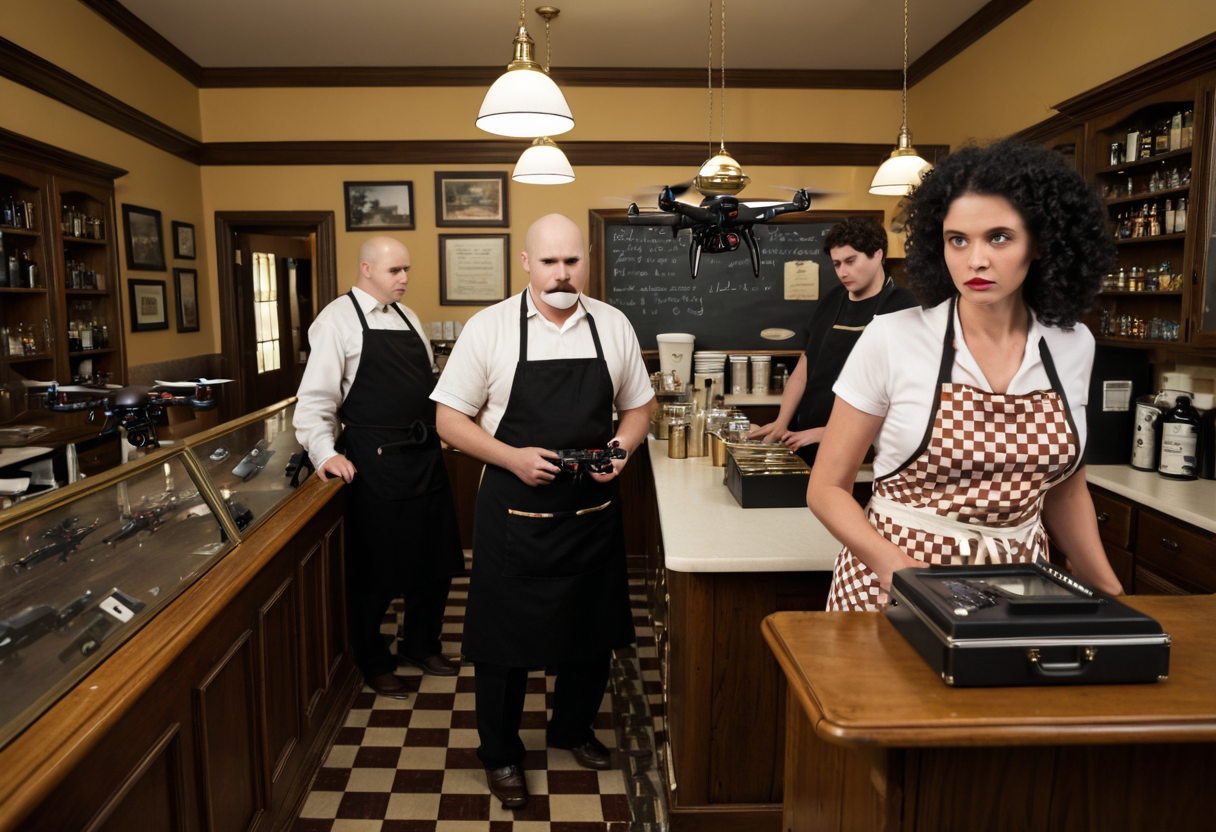
For most of my career, close air support (CAS) was a family business in the narrow sense: a small, proud guild of Joint Terminal Attack Controllers (JTACs) who held the skill, guarded the standards, and passed the trade to the next few by hand. I owe the framing to Col Dave Blair, from our time together in the office of the Air Force's Strategic Studies Group (SSG), and his point ran wider than my guild: war is the family business of the Department of War (DoW), and airpower is the family business of the Air Force. The trade is lethality — and drones are just its newest ubiquitous tool, which makes them everyone's business, not the private property of operators like me.
A guild works right up until the war needs more hands than the guild has. We're there now.
BLUF: Lethality is becoming a flow, not an inventory. Cheap, attritable, software-defined systems mean mass is made and remade continuously, not bought once and counted. A force built around a few exquisite platforms and a few specialist castes can't generate that kind of mass. The DoW has to make the trade of war a broad competence, taught from day one, not the closely held property of a handful of guilds.
Mass is back, and it's cheap
Ukraine has reportedly been deploying on the order of nine thousand drones a day, with manufacturers iterating designs and software constantly to stay ahead of jamming.[1] That is not a procurement program. It's a metabolism: build, field, learn, change, rebuild, at a tempo no exquisite platform can match.
And it's produced at industrial scale for almost nothing. Kyiv has set a target of roughly seven million drones in 2026, against a United States output measured in the low hundreds of thousands a year.[2] When a few-hundred-dollar airframe can retire a vehicle worth millions, the exchange ratio is the weapon, not the platform.
The DoW has read the lesson, loudly. Replicator opened the bidding in 2023: thousands of attritable autonomous systems on a two-year clock, to answer an adversary's mass with our own.[3] It has since been overtaken by louder commitments. A 2025 Secretary of War memorandum, “Unleashing U.S. Military Drone Dominance,” ordered a low-cost drone into every squad by the end of 2026 and drones into every major training event by 2027.[4] In 2026 the Department stood up a four-star Autonomous Warfare Command, its twelfth combatant command, to own robotic warfare outright.[5] Even DIU now frames its mission as driving down the “cost per kill.”[6] The intent isn't in question. The money and the org charts are moving.
And yet we are still paying the bill for not having cheap mass of our own. In the Red Sea the Navy has been spending SM-2 interceptors at $2.1 million each, and SM-6s north of four million, to shoot down one-way-attack drones that can cost a few thousand dollars apiece.[7] In roughly six months of the Red Sea fight, the Navy burned close to a billion dollars of air-defense missiles doing it.[8] That is the exchange ratio run backwards, fought with magazines we can't refill at the pace we empty them. And the cheap drones winning that trade fly on commercial American technology the Department spent years refusing to field, walled off by bespoke requirements and single-platform silos until the memos above finally forced the door. Signing them was the easy part. The frozen middle is what still stands between the order and the squad.
But every one of those moves buys systems or builds commands. Almost none of them crew the force. Thousands of attritable systems need thousands of people who can fly them, fix them, reprogram them, and improvise with them in the field, and a culture that treats that as everyone's job rather than a specialty. The services are creating new autonomy occupational specialties, which is a start, but a few specialist tracks are not a broadly fluent force.
You cannot buy a million-plane posture and crew it with a guild.
Lethality is a flow, not an inventory. You can't stockpile it, and you can't crew it with a chosen few.
Teach the family business
If drones are going to be as common on the battlefield as the rifle, then baseline competence with them has to be as common as marksmanship. That means teaching the family business of war and combat right from the start:
- Baseline drone literacy for everyone. Every Airman and Sailor should fly, recover, and troubleshoot a small uncrewed system (sUxS) in basic training, the way everyone qualifies on a weapon. Not to make everyone an operator, but to end the idea that this is someone else's job.
- Depth through professional military education (PME). Build the specialist tiers on top of a literate base, so the experts have a force that understands what they do instead of treating it as magic.
- Field-level adaptation as a skill. The Ukrainian edge isn't just flying drones, it's units modifying them between missions. Reward the maintainer who changes a payload or reflashes firmware in the field, because that's the labor that keeps cheap mass lethal.
- Production close to the fight. Pair the people with production nodes near the edge: high-volume assembly lines and injection molding as the default, with additive manufacturing for the parts and short runs where it actually earns its place, so mass is replenished at the tempo it's consumed.
- Data from every repetition. All of that training is also the training set. Every rep is a data point that makes the autonomy better, from the sUxS simulator we hand a teenager as a recruiting video game to the front-line maintainer's log of what broke and how they fixed it. I've written about these data and recruitment spillovers: treat the training enterprise as a sensor, not just a schoolhouse.
- Culture: everyone is in the lethality business. Fractalized lethality means the transport-aircraft maintainer, the comms troop, and the loadmaster are nodes in the kill web, not spectators to it. When a fight in the Indo-Pacific started to look real, I watched people try to transfer out because they thought of themselves as maintainers of transport aircraft, not warfighters, and didn't see that war is about lethality. That instinct is the thing to kill. In a swarm war everyone either feeds the lethality or gets in its way, and the family business is teaching the whole force to know which it's doing. Being a warfighter isn't just germane to the DNA of those in the Army and Marine Corps.
None of this displaces the guilds. As an example, the JTAC still owns the hardest end of the trade. The point is to stop letting the guild be the ceiling on how many hands the fight can use.
The same software, from the mall to the objective
Here's the part I care about most, and the part we keep leaving on the table. Build it as one backbone. The free small uncrewed system (sUxS) game we let them download for free from the Apple Store or Google Play paid for with recruiting dollars, the qualification a new recruit flies in basic, the PME module a mid-career officer works through, and the special operations forces (SOF) team rehearsing a hostage rescue on the actual objective's synthetic terrain the night before they execute, all of it the same data types, all of it writing to the same data lake.
That changes what the training is for. A recruiting game that is only a recruiting game throws away everything it learns the moment the player closes it; that's the ceiling the services have always built to. A single backbone keeps all of it. Every repetition at every skill level, from the curious kid at the mall to the Tier 1 operator on the target, becomes labeled data for the autonomy that will eventually fly the swarm. The same reps that find us talent and sharpen a SOF JTAC's high-value target (HVT) assault rehearsal are the reps that teach the machines how a human makes the call under pressure.
Recruiting, screening, training, mission rehearsal, and autonomy development stop being five separate programs with five budgets and become one feedback loop. That is the whole thesis of this series in a single system: the institution that learns from every rep, at every level, all the time, beats the one that files its training away in a binder.
The objections, answered
"Not everyone needs to be a drone operator." Correct, and that's not the ask. Everyone qualifies on a rifle; few are snipers. Baseline literacy and a specialist pipeline are different things, and you need both.
"This dilutes standards." It raises the floor without touching the ceiling. The specialist tiers keep their standards; the rest of the force stops being helpless around the most common weapon on the modern battlefield.
"We should invest in exquisite systems, not toys." We should invest in both, but exquisite platforms are what mass is designed to swarm and exhaust. A posture with no cheap mass is a small number of irreplaceable targets.
"Cheap mass is a passing fad." I remember when people said the Internet was no more game changing than the fax machine. These were the same type of people who suggested the firearm was no replacement for the longbow. With that said, we all lacked the imagination in 1990 to see what the Internet would be now in 2026. Likewise, we're watching the Sopwith Camel era of aviation for small drones. Continuously delivered software and vast data lakes of training data will be the shortcut to a "beyond-the-F-47 era" posture, and we won't have to wait 110 years.
The fix
Treat cheap mass as a people problem, not just a procurement one. Put baseline sUxS (small unmanned aerial systems (sUAS) in the Air Force, and small unmanned surface vehicles (sUSV) and small unmanned underwater vehicle (sUUV) in the Navy) training in basic for the whole force, build specialist depth through PME on top of it, reward field-level adaptation, and stand up production near the edge so mass can be replenished at combat tempo. Drone Dominance buys the systems; this crews them. One without the other is a warehouse.
What you can do Monday
- Unit commanders: Get a few cheap sUxS into your unit's hands now and let people fly, crash, and fix them. Familiarity is the whole point.
- Recruiting commands: Start looking at gaming as not merely a way to bring people into the services, but how to use that data to train the machines.
- PEOs / PAEs: Buy attritable systems as consumables with field-reprogrammable software, not as exquisite platforms with locked firmware. Quit treating a $50k drone as a manned fighter for testing, quit gating the software on board as an IT baseline, and quit trying to make platforms the program of record. Build acquisition pipelines that are designed to completely replace the entire platform from new vendors in 6-12 months instead of 10-15 years.
- Contracting officers: Write for quantity, open interfaces, and the right to modify, so units can adapt systems without a change order.
- Service personnel offices: Add baseline drone qualification to initial training and make field adaptation a credited skill, and fund gaming for recruiting with the caveat it pushes labeled data to a government administered data lake.
- DIU and the service innovation organizations: Source cheap, modifiable systems at scale and the manufacturing nodes to replenish them near the fight. Build contracts to prevent stovepiping and vendor lock, and lean on continuously deliverable software throughout the entire kill-chain.
- OSD: Make cheap mass a doctrine and a training requirement, not just a buy. Fund the crewing and the production base alongside the systems.
- Congress: No new authority needed. Ask whether Drone Dominance's systems are matched by a training and production plan to crew and replenish them, and fund the gap if they aren't.
Works Cited
5 Defense One. 2026. Hegseth Plans Autonomous Warfare Command. September 30.
6 DefenseScoop. 2026. In Its Next Chapter, DIU Aims to Reduce the Military's “Cost Per Kill.” July 15.
The conversation happens on LinkedIn — come argue with me there.