The first bombs of Desert Storm weren't aimed at tanks. On opening night, stealth fighters went for Baghdad's air defenses and the telephone exchange its command net ran on — the target aircrews nicknamed "Baghdad Bell" — to blind the enemy and cut off its head.[1] A generation later the pattern held: when the American-led campaign opened against Iran, the first hours went after the command-and-control (C2) nodes and the air defenses before anything else.[2] This is the American way of war. We decapitate.
It works so well because of who we tend to fight. An authoritarian military can't afford to let its sergeants and lieutenants make decisions in the field — a force that trusts its own people to think is a step away from becoming a free people — so it centralizes command and clutches it at the top. Cut the head and the body stops. Free people fight the other way, pushing decisions to the edge, which is exactly what makes it so hard to do the same thing back to us.
So what we're building now should stop us cold: every centralized command tree we field hands a peer competitor the one target we've spent decades teaching the world to prize. The answer to a head the enemy can sever isn't a stronger neck — a bigger, harder, more exquisite headquarters or fatter control pipes. It's a million tiny heads.
BLUF: Every C2 system we build assumes the network survives contact or else assumes the opposite, that it never works at all. Reality is somewhere in the middle. Stigmergic warfare is the answer: swarms that coordinate through the environment itself — through electronic marks they leave and read — instead of a chain of command. The mechanism is command by constraint: you pre-load the boundaries of what must never happen and let autonomous teams act on local perception inside them. That is what lets the decisive fight of the next war, swarm against swarm, happen at all when the links are down. It is not unaccountable autonomy — humans set the cages and audit the exhaust — and it removes the one thing our adversaries are most eager to kill: the headquarters.
The command tree is a target
Traditional C2 assumes two things survive contact: the communications links, and the hierarchy that rides them. Against a peer, neither does. Denied, disrupted, intermittent, and limited (DDIL) is not the degraded case we plan around as an exception. It is the default condition of modern war. The instant a swarm depends on a link back to a human in an operations center, you have built a center of gravity (COG) the enemy can find and sever, and the day they sever it your thousand drones become a thousand bricks.
We keep buying that vulnerability on purpose. Every JADC2 briefing that ends on a single screen in a command center is the command tree with better graphics, and the tree is exactly what a peer competitor has built their whole targeting enterprise to decapitate.
A headquarters the swarm can't fight without is a target you've handed the enemy.
The environment is the message
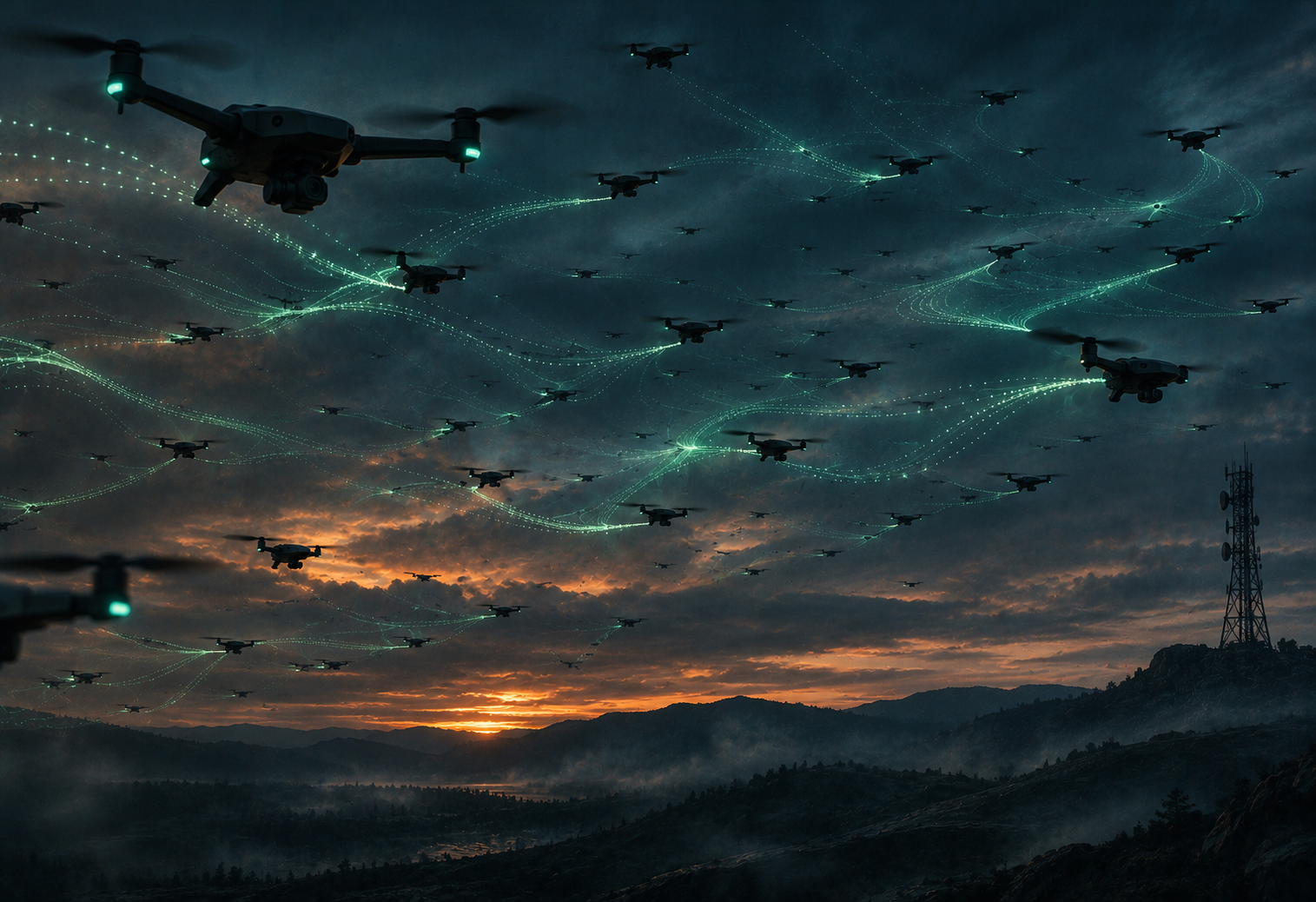
Nature solved this a long time ago. Ants and termites build without blueprints or bosses: each one reacts to local conditions and leaves a signal that steers the next. That is stigmergy, and it is how a force fights when no one is in charge — except ours leaves electronic pheromones, not chemical ones.
Strip a node of global positioning system (GPS) and broadband communications — jam it, spoof it, cut it off — and it should not go dark or dumb. It keeps emitting and reading compact electronic marks that encode its own state: the mission priority it's carrying, the rules-of-engagement cage it's operating under, how survivable it still is, and how much of the swarm around it is still alive. Every node is agentic, and every node is a sensor for the others, so the network rebuilds its picture from thousands of local broadcasts about self, mission, and the broader swarm, with nobody at the center. That is enough to keep fighting — enough for a Collaborative Combat Aircraft (CCA) to prosecute an air-to-air engagement autonomously — while GPS is gone and the satellite link is a memory. A drone that burns in place still emits one last pheromone: its position, what it saw, the threat that killed it. The survivors read that mark and adapt.
This has precedent, not just biology. The Defense Advanced Research Projects Agency (DARPA) built decentralized task allocation for small-unit swarms under its Offensive Swarm-Enabled Tactics program,[3] and Ukraine's front-line units reportedly tag radio and navigation conditions in real time to cue each other with no central control. It is the same logic the continuous authorization to operate (cATO) pipeline runs on: each agent broadcasts its own trust state — its software bill of materials (SBOM) hash, its signing chain, its last test result — and peers read those broadcasts as cues for how close to fly and whom to trust. It is evidence as trust, with no central adjudicator, pushed down to the edge.
The first shot is a lie
Because the environment is the message, deception is the opening weapon. The decisive fight is swarm on swarm, and it is an information contest before it is a shooting one. Expect an adversary to inject false pheromones — fake death markers, spoofed GPS offsets — to mimic your friendly attestation tokens and sow confusion, and to throw up electromagnetic mirror clouds that distort what every sensor thinks it sees. Before anyone fires, both swarms are already lying to each other about where they are and what's real.
The first shot in a swarm fight is a lie. The side that sorts truth from spoof faster gets to shoot second, and win.
Winning that contest is doctrine, not magic: multi-modal corroboration, so no single spoofed channel carries a decision; moving-window trust that time-limits confidence in any recent signal; and adjudication nodes that vote on contested perceptions. Make the adjudication multi-axis — fast local adjudicators execute immediate safety actions at low latency, while higher-confidence theater adjudicators re-score global trust and can revoke a bad local call. The rules for adjudication and revocation ride in the mission packet as policy code, visible to auditors after the fact.
The real fight is the spectrum
None of this survives if you lose the electromagnetic fight, which is why electronic warfare (EW) stops being a supporting arm and becomes the primary arbiter of who gets to coordinate at all. Stigmergic doctrine has to specify three things it mostly leaves to chance today: distributed spectrum agility, so agents can hop bands (and exploit the inverse-square law) and fall back to optical and acoustic cues; radio frequency (RF) provenance tokens, short signed bursts that let a drone trust a message even when the public key infrastructure (PKI) is gone; and degraded-mode behaviors, the rules an agent runs when it is jammed — play dead, emit a decoy pheromone, rendezvous by sensor. EW belongs as a funded line inside the new Major Force Programs (MFP), not bolted on after the spectrum is already contested.
A bullet is cheaper than the drone it kills
Here's the tactical punchline the exquisite world keeps missing: the lowest total cost of killing a small uncrewed system (sUAS) is expendable ordnance. A commercial off-the-shelf (COTS) rifle or pistol round costs pennies, and fired from a sUAS it becomes an absurdly cheap way to punch through a swarm. You don't answer mass with million-dollar interceptors; you answer it with cheaper mass that shoots back. That math is decisive for base defense, especially under Agile Combat Employment (ACE), where defensive drones recover, re-arm, and re-establish defensive counter-air (DCA) for a fraction of the cost of the threat they're defeating.
Sustaining that many nodes also breaks how we manage airspace and spectrum, so both become managed battlefield resources: dynamic airspace micro-cells allocated by mission intent and signed into the JADC2 registry, mission-thread spectrum zoning with pre-negotiated fallback bands, and automated deconfliction that keeps a thousand friendly nodes from killing each other by accident. That means the Department of War (DoW) working the Federal Aviation Administration (FAA) and allies now to pre-authorize tactical micro-cells, plus distributed repair and rapid-swap payload nodes so a lost drone is replaced without centralized long-haul lift.
The nervous system of the fight
Put it together and the architecture is a body, a mind, and a nervous system. Cheap mass production builds the body — the air, ground (unmanned ground vehicles, UGVs), and maritime (unmanned maritime systems, UMS) drones. Collaborative autonomy supplies the mind. Stigmergy is the nervous system that lets them act as one, trading behavioral gradients — attack here, disperse there — over JADC2 data contracts instead of explicit orders. When a node dies, its data persists. When the link breaks, local rules fill the gap. The fight continues at machine tempo after headquarters has gone silent. How we build that body and that mind — Drone Dominance and the Collaborative Combat Aircraft — is its own argument, and the next post in this series.
The objections, answered
"This is unaccountable killer robots." It's the opposite. Stigmergic autonomy runs on programmable ethics: rules of engagement (ROE) and the law of armed conflict (LOAC) are pre-loaded into every agent as policy cages it cannot cross, and arming is policy-coded: a cryptographically bound token carrying the mission predicate, a time window, the evidence that justified it, and the authorizing signatory, with hardware that refuses to arm without one. A human doesn't babysit one drone on a joystick; a human commands a behavior class, dialing aggression, proximity, and deception tolerance across the whole swarm, then audits the evidence exhaust afterward — the SBOMs, the telemetry, the decision chains — like a flight recorder. Every mission thread carries a Mission Safety Case: hazards, mitigations, fallback states, in writing. Accountability moves from moment-to-moment control to pre-mission encoding and post-mission verification, which is more auditable than a pilot's memory, not less. It also demands a force fluent enough to set the cages and read the exhaust. Besides, robot on robot violence doesn't even require a human in or on the loop anyway. Only robots that hunt human life need be accountable.
"Decentralized means uncontrolled." Command by constraint is still command. You are not giving up control; you are moving it from real-time tasking, which the enemy can cut, to the boundaries and behaviors you encode before the swarm ever launches. A commander who can define what must never happen has more control in a jammed fight than one holding a dead radio.
"Our networks will hold." They won't, and building as if they will is precisely how you lose the swarm the first time the links drop. Plan for DDIL as the rule, and the connected case becomes a bonus instead of a dependency.
The fix
Stop buying command systems that assume the network lives. Write command by constraint into doctrine: policy cages that encode ROE and LOAC, a shared electronic-pheromone standard so one vendor's drone can read another's marks, the deception-resistance to win the information contest that opens every swarm fight, EW and spectrum agility funded as first-class requirements, and an evidence-exhaust audit built in from the start. The pieces already exist — JADC2 data contracts, cATO trust broadcasts, cheap attritable mass. Stigmergy is the doctrine that makes them fight as one body the day the enemy takes the headquarters away.
What you can do Monday
- Unit commanders: Run an exercise with the data links off from the start, not cut mid-fight as a surprise, and let both sides spoof. The lesson isn't who has more drones; it's who keeps fighting, and who sorts real from fake first, when nobody can talk.
- PEOs / PAEs: Make degraded-mode behavior, a published electronic-pheromone standard, and a cheap counter-swarm shooter acceptance criteria. Reject C2 that only works connected.
- Contracting officers: Buy the data standard and the right to interoperate, plus policy-coded arming tokens and tamper-evident decision logs, as conditions of acceptance.
- DIU and the service innovation organizations: Field the EW, RF-provenance, and adjudication fabric as core swarm infrastructure, with the distributed repair nodes that sustain mass at the edge.
- OSD: Fund EW and spectrum agility inside the new Major Force Programs, make ROE/LOAC policy cages and a Mission Safety Case standard for every autonomous system, and start the FAA and allied talks on tactical airspace micro-cells now.
- Congress: No new authority needed. Ask one question of every autonomous program: what does it do when the link dies? If the answer is "wait for orders," you're buying a brick.
Works Cited
1 Air & Space Forces Magazine. 2003. The Baghdad Strikes. July.
3 Defense Advanced Research Projects Agency. Offensive Swarm-Enabled Tactics (OFFSET).
The conversation happens on LinkedIn — come argue with me there.