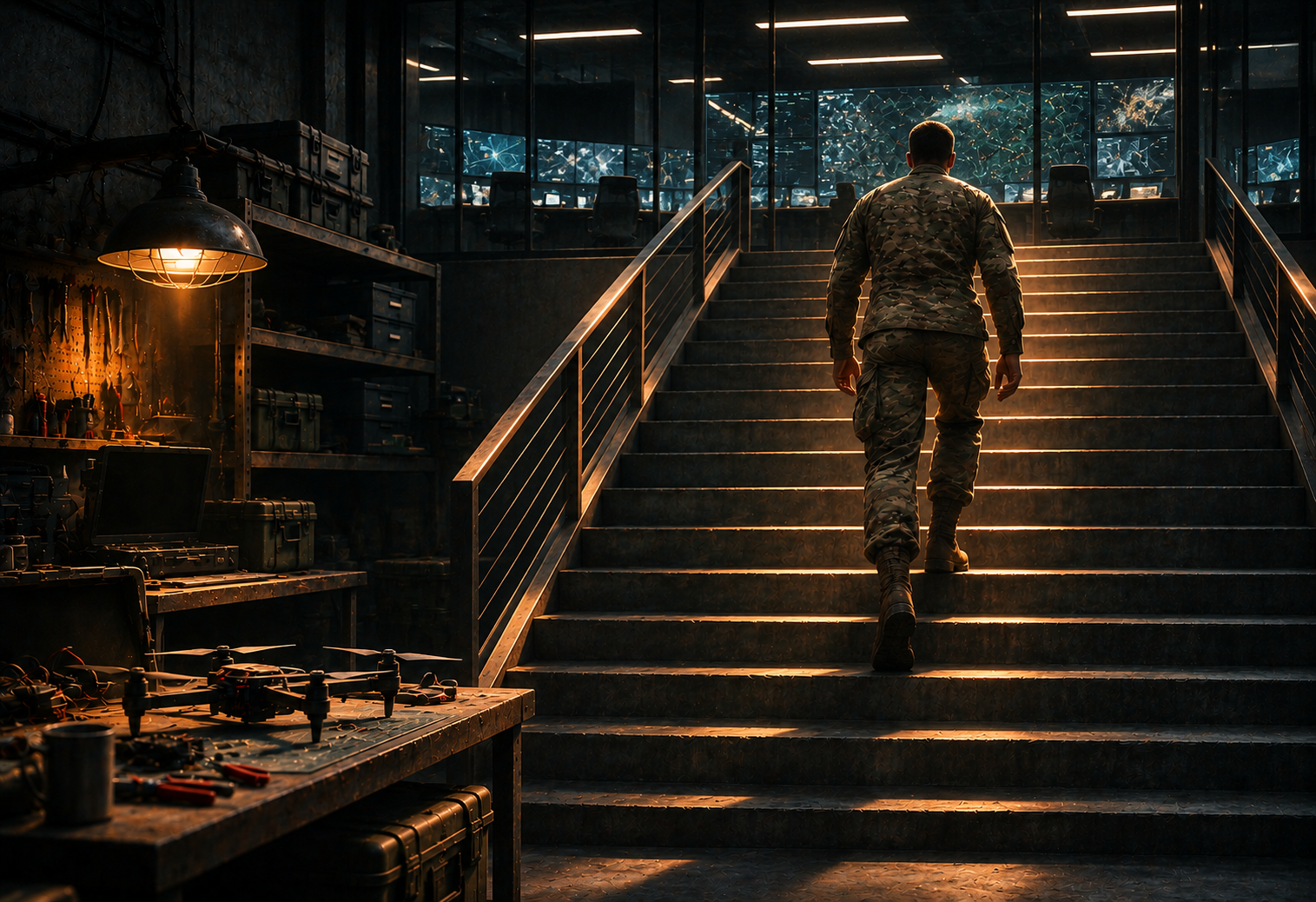
Every innovation unit I've watched succeed was carried by a handful of irreplaceable people. And nearly every one of them eventually left the service, because the personnel system had no idea what to call what they did.
It assigned them by their career field, rated them against peers who had never done anything like their job, and — when they finally walked — backfilled them with someone trained for the old world, who let the unit die from the inside. We don't have an innovation problem. We have a personnel problem wearing an innovation costume.
BLUF: Modernization that depends on heroes is a liability with a countdown. The fix isn't a new career field, and it isn't another innovation cell. It's the Pathfinder: a joint patch community, tiered like the Weapons Instructor Course (WIC) and layered on the specialty you already have, that turns adaptive integration into a credentialed profession. We've already argued who should pick these people, why the patch has to be re-earned, and where and what they should be taught. This is the ladder they climb — trained the way TOPGUN and WIC trains instructors, and pointed first at the part of the system that's actually broken.
Heroes don't scale
Nearly every defense innovation success of the last decade was personality-driven, and that's exactly the problem. The Defense Innovation Unit (DIU), AFWERX, the Army Applications Lab (AAL), NavalX, the Marine Innovation Unit (MIU) — each delivered remarkable things, and each depended on a few people the system never knew how to keep. When those people left, the capability left with them.
Here's the mechanism. The services' personnel machines assign talent by career field — Air Force Specialty Code (AFSC), military occupational specialty (MOS), rate — not by the work. The officer who can translate a warfighter problem into a deal and ship working software has no box on the form, so the machine files her under her old specialty and routes her accordingly. Keeping her in the fight takes heroics at the four-star level. More often she just leaves — and the machine replaces her with someone competent at the old world and lost in the new one, who spreads legacy culture through the unit like a cancer until nothing innovative survives. I've watched this happen more than once.
Innovation that depends on irreplaceable people isn't a capability. It's a liability with a countdown.
The answer is not to find better heroes, or to expect a market to grow under the auspices of altruism. It's to make the thing they do incentivized, with doctrine, a standard, and a patch — so the capability outlives the person, and the person has a reason to stay.
A ladder, not a billet
The WIC patch defined tactical excellence for kinetic warfare. The Pathfinder patch does the same for digital, dual-use, and acquisition warfare. It is not a new career field — you keep your AFSC, MOS, or rate and wear the patch on top, exactly as a Weapons Officer does. And like the Weapons School, it's a tiered progression, not a rank. Here is where the ladder lands in three to five years:
- Tier 1 — Tactical Integrators. After their initial tour at DIU, they sit inside operational units and stay anchored in their own AFSC/MOS/rate, but they're the innovation belly-button for that mission — exactly what a Weapons Officer is for tactics. They lead the application programming interface (API) fragmentary orders (FRAGOs), own their unit's data service-level agreements (SLAs), and inherit continuous authorization to operate (cATO) packages instead of re-papering them. Picture a Joint Terminal Attack Controller (JTAC) with a Pathfinder special experience identifier (SEI) running automated close-air-support (CAS) link testing for a Ranger battalion. They scope small, unit-funded contracts — but know how to work them so a win can scale to the enterprise.
- Tier 2 — Operational Catalysts. They sit at the Wing, Major Command (MAJCOM), Fleet, or theater level, or inside the innovation organizations like DIU, AAL, AFWERX, MIU, NavalX, SOFWERX or SpaceWERX. They lead cross-unit integration, write the multi-thread API FRAGOs, and staff work through a gig board. Spark Cell directors and their equivalents in the other services live here.
- Tier 3 — Strategic Architects. They teach, advise, and command: innovation unit leadership, portfolio leadership at DIU, professional military education (PME) chairs at the School of Advanced Air and Space Studies (SAASS), Blue Horizons, or the Warfighting Acquisition University (WarU), certification boards, doctrine. They're the connective tissue between modernization, PME, and policy.
The shape is deliberate: tactical mastery, then integration leadership, then doctrinal authority — the same climb a Weapons Officer makes, pointed at third offset problems like software and commercial acquisitions instead of ordnance. And like that patch, it's earned, not assigned. But here is the real change from the whiteboard version: the first graduates don't come out of an eight-week temporary-duty (TDY) course. They come out of a two-year billet at DIU, the way the Navy's Fighter Weapons School — TOPGUN — produces instructors through an immersive tour, not a short class. And the tour pays real career currency, not a line on an evaluation: Joint Duty Assignment List (JDAL) credit toward joint qualification for officers, and a Special Experience Identifier (SEI) plus Special Duty Assignment Pay (SDAP) for the enlisted force. Clear incentives, because a patch that costs you two years and returns nothing is a patch no one earns twice. Then you keep it only by shipping — fail to deliver a deployed artifact or a validated outcome for twelve months and it lapses. Weapons Officers say "humble, approachable, credible." Pathfinders add "auditable, interoperable, repeatable."
Climbing the ladder is how the force stays current, not just how an individual advances. A commercial tour is a graduation requirement, not a perk: before making Tier 2, a Pathfinder rotates through industry on an exchange authority — the Defense Ventures Program (DVP), Experience With Industry (EWI), or a cyber and information technology exchange program (CITEP) tour — and comes back fluent in how commercial teams actually ship. Reservists, Guardsmen, and retirees surge in through a gig board as short-term experts when a mission thread spikes. The point is a workforce that recompiles as fast as its software does.
One note on the name. I’m not married to “Pathfinder.” The Army already uses it for something entirely different that I highly respect, and as a student of Airborne history I know exactly where the torch comes from — the pathfinders who jumped into Normandy on the night of June 5th, 1944, to light the drop zones for everyone who followed. I respect that lineage too much (and rucked way too many miles at Combat Control School) to be precious about the word; call the version whatever you like. What matters is that the Air Force has already codified it as a real specialty — the 88Y and 8Y000 AFSCs now exist on paper. That’s the Service admitting this is a profession worth a code, not an additional duty waiting to be deleted. They’ve moved the ball. This post is about carrying it the rest of the way.
Start where it's breaking
That ladder is the destination, not the on-ramp — and getting the sequence wrong is how good ideas die. You don't build it bottom-up by scattering the first dozen graduates into squadrons or battalions and hoping. You start where the system is breaking today, breaking at scale, and costing the Department the most, and today the break is in acquisition, not at the line unit.
So the first graduating classes go to the program executive offices (PEOs) and the portfolio acquisition executives (PAEs). That's the move my co-author and I argue for in War on the Rocks: DIU acts as the schoolhouse — select, train, credential, place, convene — and places its graduates where a trained integrator changes the most, fastest. A Pathfinder inside a program office, fluent in both the mission and the contract, fixes the chokepoint from the inside, and seeds the very offices that will later have to accept the ladder's outputs: the interface orders, the data contracts, the reciprocity packages. Then, over three to five years, you push the ladder down into operational units until the Tactical Integrator is the innovation belly-button in every squadron, battalion, and ship. Two lenses, one design: fix the acquisition system from the inside now, and make integration native at every echelon by the time the force has to fight.
The Henry Ford of the weapons system
One role matters enough to name on its own: the Software Design and Development Supervisor (SDDS). The SDDS is the tactical glue that holds a weapon system powered by software together — someone who pairs real operator experience with design-thinking and enough software fluency to translate a mission need into runtime requirements and ride herd on the contractors building it. This is a person close enough to the mission to solve the mission thread, but innovative enough to think outside the box. The apocryphal quote attributed to Henry Ford of "If I had asked people what they wanted, they would have said faster horses" may not be true, but the adage absolutely is. The SDDS is someone with enough vision to see innovative and cutting-edge ways to help solve tactical problems that plague the actual warfighter, coupled with knowledge from a WIC-for-Acquisition skill they've maintained that means they know how to transition it.
This job has to be uniformed, not a civilian billet, and the reason is the whole argument in miniature. A program executive office (PEO) is too far from the fight to manage a software weapon at tempo. The SDDS fuses design thinking, domain tactics, and a working grasp of how requirements and budgets actually move. Around the SDDS sit three supporting specialties — a Data Strategy and Governance Manager (DSGM), an Integration and Interoperability Manager (IIM), and a Contractor and Vendor Relations officer (CVR) — who together form a micro-program office that lives inside the operational chain of command instead of a collection of spreadsheets on a distant SharePoint. The deep-expertise seats can be civilian General Schedule (GS) billets for continuity, but the SDDS stays in uniform, because the one thing you cannot outsource is the thread back to the warfighter. The DSGM, IIM, and CVR can even be a single group staffed at the Spark cell level to support all the mission threads on a base, but each tactical unit that operates a weapons system that could use innovation should have their own SDDS. That SDDS would ideally be sitting in the weapons and tactics shop next to the WIC patch, as there is no better place to fuse cutting edge research and development (R&D) with elite new tactics, techniques and procedures (TTPs).
The fix
Stand the Pathfinder (or whatever else we want to name it) up as a joint patch community, governed by a Joint Pathfinder Board (JPB) chaired by DIU with every service's innovation command at the table. Run DIU as the schoolhouse — a two-year qualifying tour that credentials with JDAL credit for officers, an SEI, and SDAP for enlisted, not an eight-week slide deck. Place the first graduates at the PEOs and PAEs, then grow the ladder down into operational units over three to five years. Tier the billets instead of grading them; codify them in each service's manning documents so they can't be quietly deleted; dual-fund them from an innovation Major Force Program (MFP) plus the host unit's own, so no commander has to starve a billet to make budget; and give the patch promotion stratification equal to a Weapons School graduate, so the ladder leads somewhere. None of it requires a new law. It requires deciding that integration and innovation is a profession worth a career and incentivizing the mavericks to keep moving forward.
The objections, asked and answered
Every reform that touches the personnel system trips the same reflex: that isn't how we assign people. Good — here are the objections this will draw, and the answers, because for a personnel reform the mechanics are the argument.
"This is just one more additional duty that gets deleted in the next manning cut." That is the exact failure mode this is built to prevent, and the prevention is structural, not a promise. The billets are codified in each service's manning documents, dual-funded from an innovation MFP and the host unit so no commander has to starve one to make budget, and tracked by a Special Experience Identifier (SEI) that travels with the person. A collateral duty has none of those three. A profession with a code has all of them.
"We already certify the acquisition workforce — why a new patch?" Because those certifications credential the acquisition workforce in place; they don't credential the uniformed operator who can carry a mission problem into a contract and back, and none of them run a tiered, instructor-grade pipeline the way the WIC does. EWI sends an officer to a company for a year; it doesn't leave behind a standard, a ladder, or a patch the force recognizes. The Pathfinder layers on top of the specialty you already hold — it competes with none of these and connects all of them.
"A two-year tour at DIU is a career-killer." Only if the services leave it one. That is the entire reason the credential has to carry JDAL credit for officers, an SEI and SDAP for the enlisted force, and promotion stratification equal to a Weapons School graduate. Wire those in and a promotion board reads the tour the way it already reads a WIC patch — as the hard job the best people get sent to do, not the detour that cost them a command. Leave them out and the objection answers itself, which is why this post keeps insisting they aren't optional.
"You'll credential them and they'll walk to industry for triple the pay." Some will, and the design assumes it. A credentialed capability is institutional, not personal — the patch, the doctrine, and the standard outlive any one holder, which is the entire point of refusing to run on heroes. Right now every hero that does this job runs to industry as fast as possible; I know, because I did, as did the vast majority of my fellow innovators as the services shoved us out and disincentivized us to stay as much as possible. The reserve and gig-board surge paths pull that industry-sharpened expertise back when a mission thread spikes, and the harder question underneath — how you build a workforce you expect to keep only in part — is its own design problem and the subject of a later post in this series. A ladder worth climbing is also the best retention tool there is.
"Make everyone a Pathfinder and the patch stops meaning anything." Which is why it's earned, not assigned, and tiered like the school it's modeled on. A Tier 1 Integrator is the innovation belly-button for a mission thread, not a sticker for everyone in the unit; the currency lapses the moment you stop shipping; and a patch that costs two years is one nobody earns twice for show. Just as I used to feel like I had to earn my beret every day, the same is true for a patch of this prestige. Scarcity is a property of the standard, exactly as it is for the Weapons Officer.
"This needs a new law and new money." It needs neither in bulk. The other-transaction authority the contractors supporting these teams run on already exists in statute, and the billets are paid by reallocating existing manning and an innovation program line, not by standing up a new appropriation. What the reform actually requires is a decision — that commercial innovation, software-defined warfare, and integration is a profession worth a career path. That part is free.
What you can do Monday
- Unit commanders: You're both the destination and the starting line — the first wave lands at the program offices before it reaches you. In the meantime, if you're Air Force or Space Force, codify a Pathfinder billet at your unit now so you can be a landing zone. Then nominate your sharpest operator for the DIU tour and protect the billet while they're gone. In the future, your unit will get an innovation belly-button and actually be part of the Third Offset instead of just another cog in McNamara's Department.
- PEOs / PAEs: You get the first graduates — take them. A Pathfinder inside your program office is the fastest fix to the acquisition chokepoint there is. Host the GS versions of the DSGM, IIM, and CVR seats, and demand prior Pathfinder experience for them in the future.
- Service personnel offices (A1/G1/N1): This is where the reform lives or dies. In the other non-DAF services, create the equivalent of the Pathfinder SEI, wire in the JDAL credit and the SDAP so the incentives are real, codify the billets in your manning documents, and give the patch promotion stratification equal to a Weapons School graduate. Stop routing these people by their old AFSC/MOS/rate alone.
- DIU and the service innovation organizations: Run the schoolhouse — the two-year qualifying tour, the curriculum, the certification standard — and the dashboards that show active patch-holders by tier and whether they're still shipping. This is the War on the Rocks model made real.
- OSD: Dual-fund the billets from the innovation MFP and the host MFP so they can't be starved, and make a tiered Pathfinder community a condition of standing up any new innovation organization.
- Congress: No new authority needed — this is a decision to codify and fund billets, not a law to pass. The authority these teams run on already exists in statute;[1] the civilian integrator seats (DSGM, IIM, CVR) are ordinary General Schedule positions, and the uniformed billets and their incentives sit within the manpower and special-pay authorities the services already use. What's missing is the decision, not the statute — and in a future post we'll lay out what Congress does have to do to make the broader machine work. In oversight, ask one question of every innovation organization: are your integrators codified, funded billets with a career path, or additional duties waiting to be deleted? If it's the latter, you're funding another unit that dies when its best person PCS's.
The conversation happens on LinkedIn — come argue with me there.