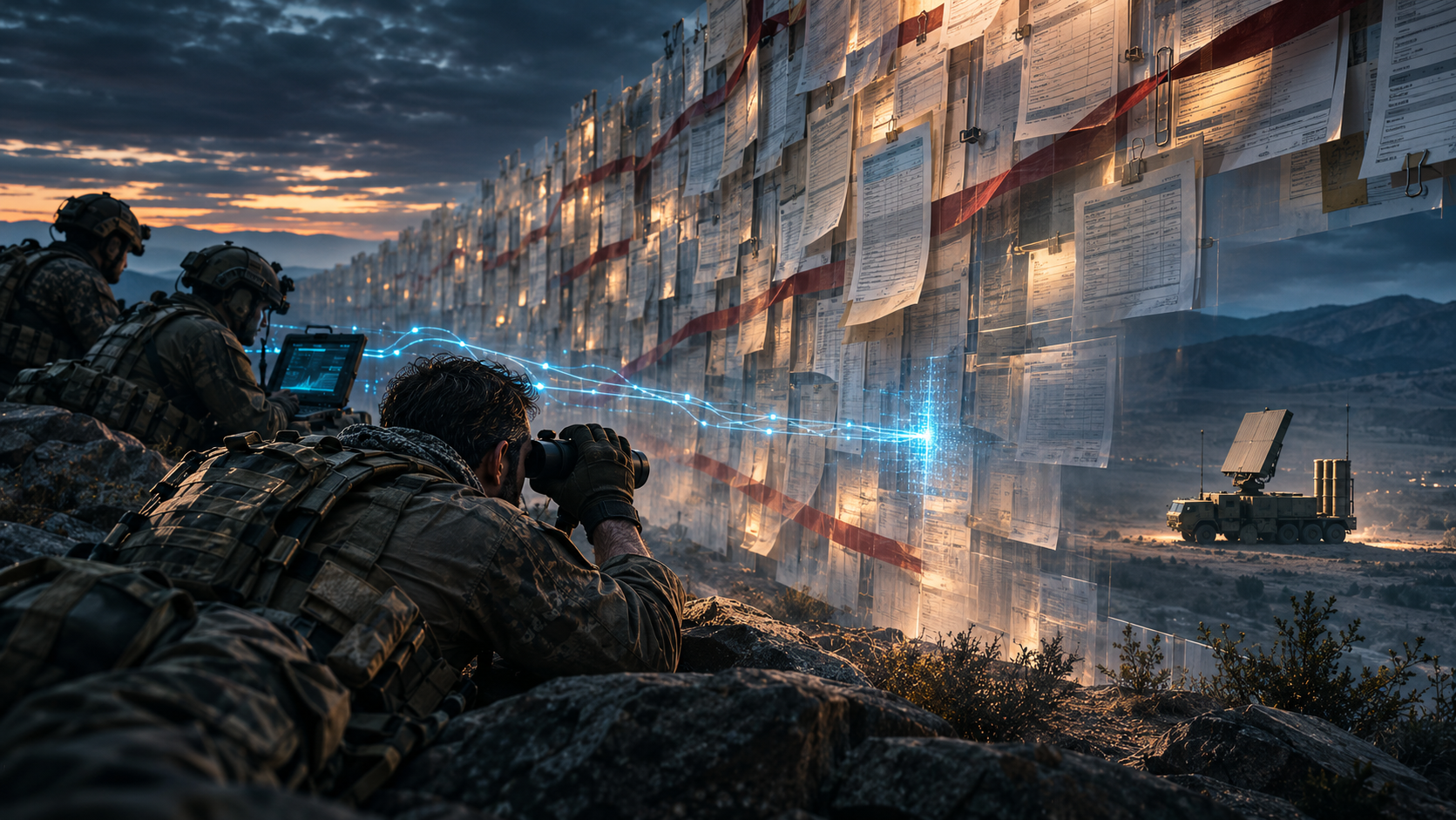
Years ago I wrote up a fight I never want to have. I was the Air Force Joint Terminal Attack Controller (JTAC) attached to an Army Special Forces (SF) team, and in the scenario we came off a ridge and found an enemy formation sitting under an SA-22 — a Russian air-defense system that can throw 30-millimeter guns and surface-to-air missiles at roughly a dozen targets a minute.
I had fast air. I could put an aircraft and a small-diameter bomb on that formation. But the SA-22 would swat the jet out of the sky before it ever got close, and I had no artillery to kill the launcher first. There was exactly one thing in the United States arsenal that could have opened a ninety-second window — a cyber effect to blind that air-defense system at the moment of the strike. It exists. I just couldn't have it, because getting it would have taken days. I wrote that scenario up in 2018, in the Air Land Sea Bulletin, under a title that was the whole argument: "The 'Intelligence-Centric' Approach to Cyberspace Hampers Multidomain Warfare."
BLUF: We built cyber as strategic magic and locked it behind the intelligence community (IC) wall, where every effect is guarded like a nuclear secret and priced in days of coordination. The result is that there is no tactical cyber — no cyber fire a maneuver commander can call the way he calls for artillery. "Fight tonight" is a slogan as long as the cyber round takes a week to chamber. The fix is to treat cyber as a fire: pull tactical effects out from behind the wall, put the authorization in the commander's hands, and stock the magazine from the private arsenal we just talked about unlocking. The Department of War (DoW) already knows how to do this with bombs. It refuses to do it with code.
The wall is the point
Cyber Command (CYBERCOM) grew up inside the intelligence world, dual-hatted with the National Security Agency (NSA), and it inherited that world's instincts: protect the access, hoard the exploit, approve nothing without a long chain of equities review. That is exactly right for a strategic campaign, where a single zero-day is a crown jewel you spend once. It is exactly wrong for a sergeant on a ridge who needs an effect in the next ninety seconds.
I made the long-form version of this case earlier in this series: cyber is a maneuver domain, and we keep treating it like exquisite, intelligence-gated magic reserved for the big day. Here I only care about the tactical consequence. We have no real tactics, techniques, and procedures (TTPs) for cyber support of maneuver warfare, because the organization that owns the capability measures success by the secrets it keeps, not the fights it wins. The wall that protects the strategic exploit is the same wall that keeps the tactical effect days away from the man who needs it. The wall isn't a bug. It's the design.
The SA-22 wasn't the thing that beat us. Our own approval chain was.
The standard isn't the virtuoso
None of this is a knock on the operators. The handful of virtuosos who pulled off the famous strategic zero-days are genuinely brilliant, and what they did in their era was extraordinary. But they are not a model you can field. You cannot put a once-in-a-decade exploit in every brigade any more than you can put a Medal of Honor in every rucksack. A force runs on the standard, not the exception, and we have no standard for cyber at the tactical edge at all.
Meanwhile the other side already does. Russia will throw a distributed denial-of-service (DDoS) attack at the tactical level of warfare — against the command net of the unit it is about to hit — the same way it throws artillery, and it has been fusing those effects with maneuver since Georgia in 2008. That is not a crown-jewel zero-day. It is a cheap, repeatable, tactical cyber fire, employed by a formation that organized to use it. We have the better operators and none of the organization. They have the better organization and plenty of good-enough operators. In a real fight, organization wins.
In this modern era of artificial intelligence (AI) driven cyber exploitation, which many of us are experiencing first-hand at the airport or even the grocery store, the ability for a zero-day to be found, weaponized, used, and then patched and closed in hours or even minutes is massive right now. Tactical operators need access to these tools on the battlefield, not merely in a windowless room in Maryland.
Our org chart is a sabotage manual
In 1944, the Office of Strategic Services (OSS) — the outfit Bill Donovan built that became the CIA and US Army SF, and was quite recently revived in the DoW — published a field manual for ordinary citizens behind enemy lines who wanted to wreck a factory or a government office without getting caught. The genius of the Simple Sabotage Field Manual is that the most effective sabotage looks exactly like diligent bureaucracy. Among its instructions to the would-be saboteur:[1]
"Insist on doing everything through 'channels.' Never permit short-cuts." "When possible, refer all matters to committees, for 'further study and consideration.'" "Haggle over precise wordings." "Refer back to matters decided upon at the last meeting and attempt to re-open the question of the advisability of that decision." "Advocate 'caution'… urge your fellow-conferees to be 'reasonable.'" "Be worried about the propriety of any decision — raise the question of whether it lies within the jurisdiction of the group or whether it might conflict with the policy of some higher echelon."
Read that list again, and then read the process for requesting a tactical cyber effect. They are the same document. We have built, in good faith and with real security concerns, an approval chain that an enemy saboteur in 1944 would have recognized as a finished work of art. By the manual's own logic, the Army major who bounces your storyboard back a third time to re-litigate the font choice isn't being a stickler — he is an enemy agent nobody even had to recruit. Somewhere, Bill Donovan is nodding. The SA-22 doesn't have to beat our pilots if our own staff process beats them first.
The fix: make cyber a fire
We already solved this problem for airplanes. A JTAC can bring a bomb off a jet and onto a target in minutes because we built the tactics, the training, the authorities, and the trust to let the person at the edge call the effect — inside clear rules, with the risk accepted by a commander in the fight, not a staff in another time zone. Do the same for cyber. Three moves, all of which this series has already laid the track for.
Put the effect in the fires process. A tactical cyber effect should ride the same joint targeting cycle as any other fire, with pre-planned, pre-authorized options a commander can pull from — not a one-off request that starts a week-long equities debate. Move the authorization to the edge. Express the rules as code and let the commander own the risk decision, the same way we trust that commander to authorize lethal force; a continuous authorization to operate (cATO) is what makes "act inside the envelope" real instead of a slogan. Stock the magazine from the arsenal. The repeatable, tactical-grade capability does not have to come from the same shop that guards the strategic crown jewels; it can come from the private cyber arsenal we'll detail later in this series as well as from outputs from the Blue List. Keep the exquisite strategic exploits behind the wall. Pull the tactical fires out in front of it.
None of this asks the IC to give up the secrets that genuinely need protecting. The strategic zero days are going to be systemic flaws that aren't easily found by a frontier model and those should be locked up behind 83 signatures and only used for the most exquisite tasks.
A tactical effect doesn’t run on those crown jewels. It runs on the vulnerabilities the commercial world is already finding in the wild — the common vulnerabilities and exposures (CVEs) and known exploited vulnerabilities (KEVs) that get published, weaponized, and patched on a timeline measured in days. I drew that line in the 2018 piece, and it has only gotten sharper: in the last two weeks, frontier AI models turned loose on code have exploded the rate at which industry finds these flaws. That short shelf life is the whole point. A vulnerability that will be patched by Friday is worthless for a long-game strategic exploit — and ideal for a tactical operator with an exploit framework who needs a ninety-second window at the skirmish this afternoon. Build the tactical lane on the firehose everyone else is already drinking from.
It asks us to stop pretending that every line of offensive code is Oppenheimer's notebook, and to admit that a maneuver force without organic cyber fires is a force fighting with one hand zip-tied by its own headquarters.
What you can do Monday
- Unit commanders: Put "no organic cyber fires" on your readiness brief as the gap it is. You would never accept "artillery takes six days to authorize" as fight-tonight ready; stop accepting it for cyber.
- Fires and targeting staffs: Build pre-planned, pre-authorized tactical cyber options into the joint targeting cycle now, against the threats you actually face — the air-defense node, the command net — so the request isn't invented under fire.
- Contracting officers: The repeatable capability is a commercial buy, not a program of record. Put it on a vehicle that can be ordered at the speed of the fires process, not the speed of a formal acquisition.
- CYBERCOM and the service cyber components: Split the mission honestly. Guard the strategic exploits behind the wall; stand up a tactical-fires line that answers to the warfighter's clock and accepts the warfighter's risk. The two are not the same job and should stop pretending to be.
- OSD: Write the tactics, techniques, and procedures for cyber as maneuver that the force still doesn't have, and resource the training pipeline that turns them into a standard instead of a story about a virtuoso.
- Congress: Ask one question in oversight: can a tactical commander get a cyber effect inside the timeline of the fight she is in — yes or no? If the answer is "it depends on an equities review," you have found a readiness gap the enemy already knows about.
The conversation happens on LinkedIn — come argue with me there.